
Reviewed · WALKING TOURS
Central Oslo Guided Walking Tour with Local Guide
Oslo’s best introduction may be a simple walk from the Tiger sculpture at Central Station to the Royal Palace. In two hours, you move through the city’s main historic and civic quarters, with stops at the Opera House, Akershus Fortress, City Hall, Aker Brygge, Parliament, and the Cathedral.
I like the low price, about $16.94 per person, and the way the route helps you get your bearings before exploring alone. I also like the guides’ practical style. Suzanne, Alexia, Marta, Daniel, and others have been praised for clear stories, humor, and useful advice about what to see next.
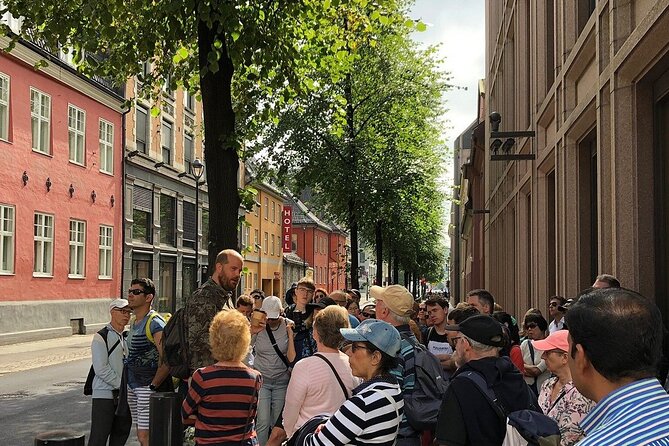
The main trade-off is that this is a walking overview, not a museum tour. Despite the mention of Akershus Castle as a stop, the tour does not include entry inside buildings. Groups can reach 27 people, and some parts of the route cover several city blocks.
Key points to know before booking
- The route crosses central Oslo in two hours, making it a useful first-day orientation walk.
- The Tiger sculpture begins the tour, explaining Oslo’s nickname as the Tiger City.
- Akershus Fortress is viewed as a historic site, but building admissions are not included.
- The guide provides the real value, with humor, local context, Norwegian history, and answers to questions.
- The finish at the Royal Palace is well chosen, leaving you near one of Oslo’s most recognizable landmarks.
- The pace is manageable for many people, but you should be comfortable walking several blocks in city conditions.
Why this walk works as a first look at Oslo
This tour links Oslo’s major sights in a sensible westward route. You begin at Jernbanetorget, close to Oslo Central Station, and finish at Slottsplassen in front of the Royal Palace. Along the way, the guide adds the stories and connections that are easy to miss when you walk the same streets alone.
You get a broad picture rather than a long stop at one monument. The route covers royal power, parliament, religion, trade, waterfront redevelopment, medieval defense, and modern architecture. That range gives you a useful map of the city’s identity.
The tour is offered in English and includes a personal guide for the group. Guide quality matters here because the sights are mostly viewed from outside. Names praised in past bookings include Suzanne, Alexia, Marta, Daniel, Kamil, and Camille, though your guide will depend on the date.
A portable speaker system is sometimes used, which helps around traffic and city noise. One practical warning: a few people have found that guides can speak quickly, and even a microphone does not solve every sound problem in a large group. If you have trouble hearing, move closer to the guide early.
More Walking Tours in Norway
- Oslo Nature Walks: Island Hopping Tour
★ 4.8 · 2,713 reviews - Oslo Nature Walks: Island hopping
★ 5.0 · 570 reviews - Oslo: Best of Oslo Walking Tour
★ 4.5 · 458 reviews
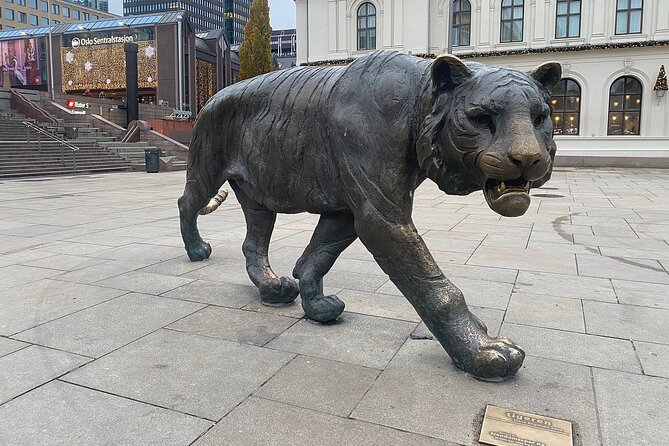
Starting with Oslo’s Tiger at Jernbanetorget

The meeting point is the Tiger sculpture, or Tigeren, at Jernbanetorget. The large bronze tiger was installed in 2000 for Oslo’s millennium celebration. It represents the city’s nickname, Tiger City.
The nickname comes from a poem comparing a city to a tiger and the countryside to a tame horse. The sculpture makes a good meeting point because it is easy to recognize and sits by Oslo Central Station.
You spend about 10 minutes here. That is enough time for an introduction, a few photographs, and an explanation of how Oslo developed as Norway’s capital. The location also makes the tour convenient if you have just arrived by train.
This first stop sets the tone. You are not simply ticking off monuments. You are learning how a city chooses to represent itself, and why a tiger became part of Oslo’s public image.
The Opera House and Oslo’s modern waterfront
The Oslo Opera House is one of the tour’s most striking changes of scene. Completed in 2008, it is home to the Norwegian National Opera and Ballet and is known for its modern design beside the water.
The building is especially useful as a contrast with the older parts of the route. Oslo is not only a medieval fortress and 19th-century boulevard. It is also a city that has reshaped its waterfront with major cultural buildings and public spaces.
The tour treats the Opera House as an outside sight, so you should not expect a performance visit or an interior tour. Still, the building helps explain the direction of modern Oslo and gives the walk an early architectural highlight.
If you are taking photographs, this is one of the places where you will want a moment to look beyond the guide. The tour keeps moving, so have your camera ready and listen for the cue to regroup.
Rådhusgata and the older city center
Rådhusgata brings the route into Oslo’s older central streets. The road dates from the 1620s and leads toward City Hall. Its age gives you a sense of the city’s earlier street plan, before Oslo grew into the capital you see today.
This part of the walk is valuable because it connects separate sights. Instead of treating each monument as an isolated photo stop, the guide can explain how streets, government buildings, and the harbor fit together.
You spend around 10 minutes in this area. Expect a short talk rather than a formal visit inside a building. The best reason to pay attention here is context: the street helps tie Oslo’s older urban development to the civic center near City Hall.
More Walking Tours in Oslo
- Oslo: Guided Walking Tour of Central Oslo
★ 4.7 · 438 reviews - Oslo: Historic Myths & Legends Evening Walking Tour
★ 4.8 · 408 reviews - Taste of Oslo Walking Tour
★ 4.5 · 282 reviews - Oslo: Snowy Forest Torchlight Walk with Campfire
★ 4.6 · 254 reviews
Akershus Fortress, from medieval defense to modern museum
Akershus Fortress is the route’s strongest medieval stop. The castle began around 1299 as a defensive stronghold protecting Oslo from invasion. Over time, it served as a military base and prison, and it is now a museum and historic site.
This is where the tour’s description needs a little care. Akershus is included as a stop, but the experience does not include visits inside any buildings. You should expect to see the fortress area and hear its story, not receive admission to the castle museum or interior rooms.
That limitation is not a major problem for a short city walk. The fortress gives the guide a chance to explain Oslo’s strategic position and the changing role of the site. If you want detailed rooms, exhibitions, or a longer study of the castle, plan a separate visit.
The fortress also adds variety to the walk. After the modern Opera House and historic street grid, you reach a place built for defense. It is one of the stops that makes the two-hour route feel like more than a stroll through shopping streets.
City Hall and the Nobel Peace Prize connection
Oslo City Hall is a major civic landmark, built between 1931 and 1950. It is associated with Norwegian government, culture, and public life, and it hosts the annual Nobel Peace Prize ceremony.
The tour allows about 15 minutes here, one of the longer stops. That gives the guide time to explain the building’s role and the meaning of the Nobel ceremony without turning the walk into a long lecture.
Again, the visit is outside only. You will not enter City Hall as part of this booking. If seeing the interior matters to you, check separately for admission and opening arrangements rather than assuming this tour covers it.
City Hall is also a useful point for understanding Oslo’s relationship with the harbor. The route begins to show how public buildings, waterfront spaces, and pedestrian areas shape the center of the capital.
Oslo Cathedral and Karl Johans gate
The Oslo Cathedral dates from 1697 and is known for its Baroque design. It remains an important religious and cultural site in the city, but this tour does not include an interior visit.
The cathedral helps round out the story of Oslo’s institutions. You see military power at Akershus, civic power at City Hall and Parliament, royal power at the palace, and religious life at the cathedral.
From there, the walk reaches Karl Johans gate, Oslo’s main street. It runs from Oslo Central Station to the Royal Palace and is lined with historic buildings, shops, restaurants, and cultural sights.
You spend about 10 minutes on Karl Johans gate. That may sound short, but the street itself is part of the route toward the palace, not a shopping excursion. The guide can point out how this long avenue links the capital’s most important public places.
This is also a good location for practical questions. Ask your guide where to return later, which sights need more time, or how to reach places beyond the walking route.
Aker Brygge and the harbor side of Oslo
Aker Brygge provides another sharp contrast. The area began as a shipyard in 1854 and was redeveloped in the 1980s into a district of shops, restaurants, entertainment, and waterfront paths.
The tour gives you a look at Oslo’s more polished harbor side. You can see how former industrial land has been turned into a place for dining and leisure, while still remaining closely tied to the water.
Aker Brygge is not presented as a restaurant stop, so do not book the walk expecting free time for a meal. Think of it as a short orientation to an area you may want to return to after the tour.
I find this stop particularly useful for planning the rest of your stay. The route shows you where the waterfront district is, how it relates to City Hall and the fortress, and why it is worth adding to your own Oslo schedule.
Parliament and the final view of the Royal Palace
The Storting building is home to Norway’s Parliament. Constructed between 1861 and 1866, it represents the country’s legislative life and adds another important institution to the route.
The building is viewed from outside. The guide can place it in the larger story of Norway’s government and national development, alongside City Hall and the Royal Palace.
The tour ends at Slottsplassen, the square in front of the Royal Palace, known in Norwegian as Det Kongelige Slott. This is a strong finish because you arrive at one of Oslo’s clearest symbols of national identity rather than ending beside a random street corner.
The end point also leaves you in a useful part of the city. From there, you can continue along Karl Johans gate, return toward the central station, or spend more time around the palace area. The tour does not include a palace visit, so plan separately if you want to see inside.
What the guides add to the experience
The route is easy to follow on a map. The guide is what turns it into a worthwhile booking.
The strongest guide style reported for this experience combines historical facts with humor and conversation. Daniel, Suzanne, Alexia, and Marta have been singled out for being friendly, clear, and good at handling questions. One guide was praised for explaining Norwegian culture alongside history, while another used stories about Scandinavian rivalry with Sweden and Denmark to make the past easier to follow.
That approach suits Oslo. You do not need a long academic speech about every building. You need a clear explanation of why the fortress matters, how the capital changed, and what Norwegian institutions mean today.
Quality can vary. One booking produced a very surface-level experience, and another guide spoke so quickly that some information was hard to catch. The large group limit is 27 people, though groups of around 20 are also possible. A good guide can keep people together, use a speaker, and make the walk feel personal. A weaker presentation will feel more like a list of landmarks.
Pace, group size, weather, and value
The advertised duration is about two hours. That is enough time to cover many central sights, but not enough to enter several museums or linger at each landmark.
The pace is generally described as easy to moderate, with time for questions. You should still expect to walk several blocks. If you have difficulty walking, note that the route is extensive even if it is not described as strenuous. Rain is another factor. The experience requires good weather, so bring suitable clothing and comfortable shoes when conditions look uncertain.
At about $16.94, this is a strong-value orientation for a first day in Oslo. You are paying for a guide who connects the sights, not for admission tickets. Since the route does not include interiors, the value depends on how much you want historical explanation and city bearings.
The experience has a 4.7 rating from 278 reviews, with 94 percent recommending it. Those figures suggest dependable appeal, but they do not guarantee the same guide or the same group atmosphere every time. I would book it for the route, price, and chance to ask local questions, then choose separate visits for museums and interiors.
Free cancellation is available if you cancel at least 24 hours before the start time. Last-minute changes are not accepted, and a weather or minimum-participant cancellation offers either another date or a full refund.
Who should book this Oslo walk
I would recommend it most strongly for first-time visitors, couples, families, and anyone arriving in Oslo with only a loose plan. It gives you a practical map of central Oslo and helps you decide where to spend more time.
It also works well for people who like history but do not want a formal lecture. The best guides use humor, short stories, and local context. Families can benefit from the variety of the route, especially the Tiger, fortress, waterfront, and palace.
You may want something else if you need museum access, a very small private group, or a slow architectural study. The tour can include up to 27 people, and the buildings are viewed from outside.
Should you book the Central Oslo Guided Walking Tour?
Book it if you want a cheap, efficient first look at central Oslo and value a guide’s stories more than interior admissions. The route covers a lot without demanding a full day, and the finish at the Royal Palace makes it easy to continue exploring.
Skip it if you already know central Oslo well or want a specialist tour focused on one subject. For most first-time visitors, though, the combination of price, location, and broad coverage makes this a sensible start. Arrive ready to walk, listen for the guide, and save time later for the buildings you want to enter.
FAQ
How long does the Central Oslo Guided Walking Tour last?
The tour lasts approximately two hours.
Where does the tour start?
It starts at the Tiger sculpture at Jernbanetorget, 0154 Oslo, Norway.
Where does the tour end?
It ends at Slottsplassen 1, in front of the Royal Palace, also called Det Kongelige Slott.
What language is the tour offered in?
The tour is offered in English.
Is the Tiger sculpture included?
Yes. The group begins at the Tiger sculpture, and the stop is free of admission charges.
Can I enter Akershus Castle during the tour?
No. The tour does not include visits inside buildings. Akershus Fortress is included as an outdoor sightseeing stop.
Does the tour include entry to the Opera House or Oslo Cathedral?
No. Building admissions are not included.
How large can the group be?
The maximum group size is 27 people.
Is the tour suitable for people who have difficulty walking?
The route is described as manageable for most participants, but it covers many city blocks. Anyone with walking difficulties should consider the distance before booking.
Can I cancel for a full refund?
Yes, if you cancel at least 24 hours before the experience starts. Cancellations or changes made less than 24 hours before the start time are not refunded.
Just added around Oslo
- Oslo Winter Highlights Bike Tour★ 5.0 · 36 reviews
- Unknown war. Oslo and Norway during 1940-45★ 5.0 · 74 reviews
- The Viking Planet Museum – Mini Group (4 adults)★ 4.0 · 16 reviews
- 4 hours Best View of the Oslofjord Winter Edition★ 4.0 · 15 reviews
- The Ultimate Norwegian Skiing Experience★ 5.0 · 16 reviews
- The Ultimate Study of the Human Form at Vigeland’s Sculpture Park with a Local★ 4.0 · 14 reviews
- The Viking Planet Museum Ticket★ 4.0 · 197 reviews
- The Oslo Beer Adventure★ 4.5 · 11 reviews
Walking Tours, compared.



Past & Present Small Group Guided Walking Tour
Read our review →
Walking Tour in Bergen of the Past and Present
Read our review →
Browse the lists this tour appears in