
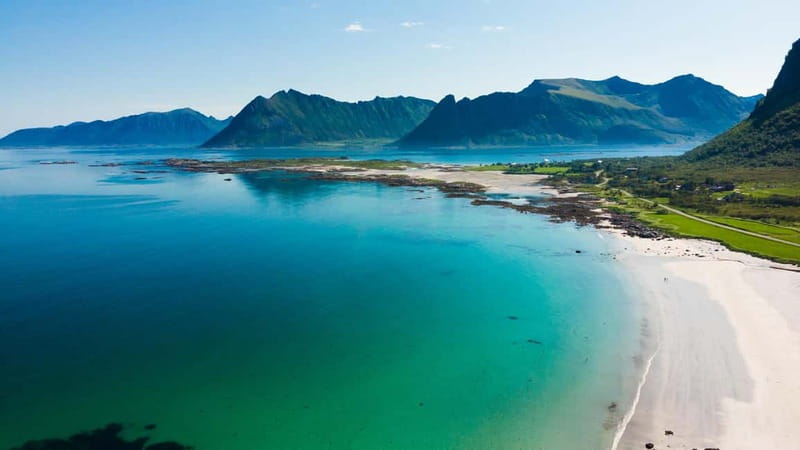
Reviewed · PHOTOGRAPHY SESSIONS
From Svolvaer: 2- Day Lofoten Highlights Photo Tour
Lofoten is at its best when you can slow down for the light, and this two-day photo tour from Svolvaer to Reine gives you time to see both the famous postcard stops and quieter corners. You cross much of the archipelago, with a professional photographer guide helping you make sense of the views rather than simply pointing out the next stop.
I like the very small group format, especially for photographers who may want a few minutes with a tripod or need help choosing a viewpoint. I also like the hotel pickup and drop-off, since Lofoten’s roads are scenic but demanding, and a local driver can focus on the route while you watch the mountains and water.
The main consideration is the pace. Two days cover a large stretch of Lofoten, so you will spend plenty of time in the vehicle and may not control every stop or departure time. The advertised group size also needs checking: the highlights say a maximum of seven adults, while the practical details say up to 12 participants.
Key points to know before you book
- Svolvaer to Reine in two days: This covers a broad section of the archipelago, including Hamnøy, Sakrisøy, Reine, Henningsvær, Kabelvåg, and several beaches and viewpoints.
- A guide who also drives: Your English-speaking professional guide provides local context, handles the road, and helps you line up photographs.
- Tripod available on request: Ask for one when booking if you need it. Food, drinks, and entrance fees are not included.
- Hotel pickup in Svolvaer: Wait in your hotel lobby 10 minutes before pickup and provide your mobile number and hotel name.
- Weather shapes the route: The order of stops is not fixed. Lofoten Lights chooses the sequence according to weather, availability, and the guide’s decision.
- Best for adults who can manage a full sightseeing day: The tour is not suitable for people with mobility, hearing, or visual impairments, and several age restrictions are listed.
Why this route works for a photo trip
Many Lofoten outings focus on one village or one short section of road. This experience takes the wider view. Across two days, you see the archipelago from Svolvaer in the north to Reine in the south, with time for beaches, fishing villages, old buildings, fjord views, and moving water.
That range matters for photography. You are not limited to one type of scene. One stop may give you white sand and clear water, another red fishing huts, another a church or a narrow channel with strong currents. The changing subjects can help you avoid a day of nearly identical mountain photographs.
The guide is a professional photographer, licensed driver, and local escort in one. That combination is useful in Lofoten, where the quality of a photograph can depend on a small change in position, weather, tide, or available light. The tour is not described as a formal camera class, so do not expect a structured lesson in exposure or editing. Think of the guide as someone who helps you find good angles and makes the journey more productive.
The itinerary order remains flexible. That is a real benefit in a place where clouds, rain, wind, and changing light can alter the look of a viewpoint. It also means you should not plan a particular stop for a specific time without confirming with the operator.
More Highlights Tours in Lofoten
- Svolvaer: South Lofoten Top Highlights Photo Tour
★ 4.7 · 62 reviews - From Svolvær: Best of Lofoten Tour in One Day
★ 4.5 · 37 reviews - From Svolvaer: 2-Day Lofoten Highlights Photo Tour
★ 4.9 · 32 reviews
Day one: Ramberg Beach, Flakstad, and the road to Reine
The first day takes you toward the southern part of the archipelago, with a sequence of classic Lofoten scenes. The exact order may change, but the listed stops make a strong full-day route.
Ramberg Beach and its Arctic Copacabana nickname
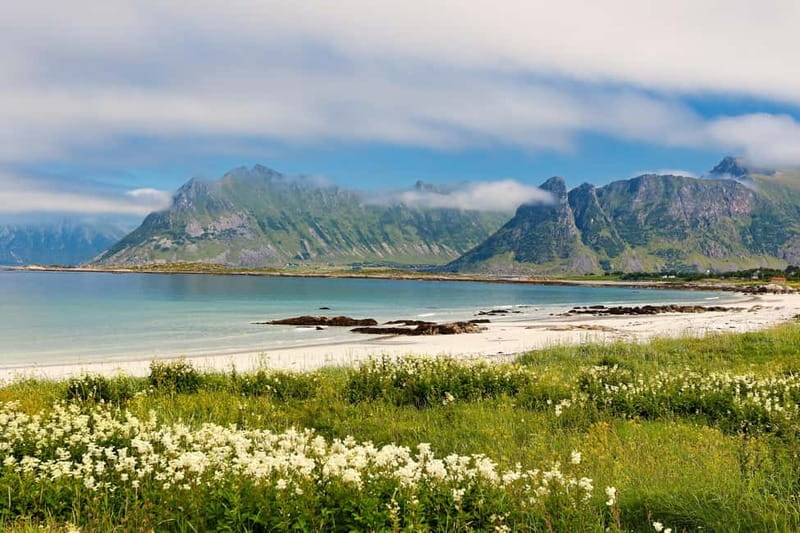
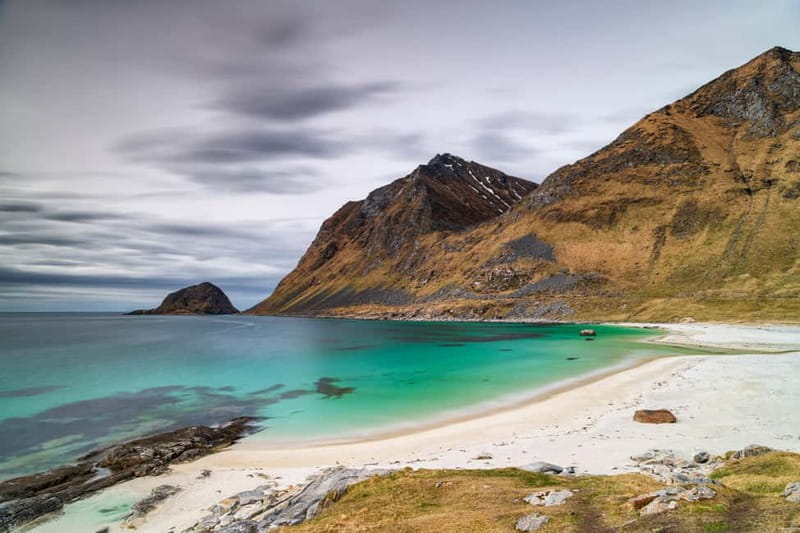
Ramberg Beach is known for white sand and clear water, an unexpected sight this far north. The open shoreline gives you room for wide photographs, with the contrast between pale sand, water, and steep mountains doing most of the visual work.
This is a good early stop because it offers a simple composition. You can work with the curve of the beach, the waterline, or the surrounding peaks without needing a complicated subject. Conditions will matter greatly, though. Cloud, wind, and light can make the same beach feel calm, dramatic, or quite ordinary.
Do not read the beach nickname as a promise of warm swimming conditions. The attraction is the setting, not a tropical climate. Bring clothing for wind and changing weather, even in summer.
Flakstad Church and an older side of Lofoten
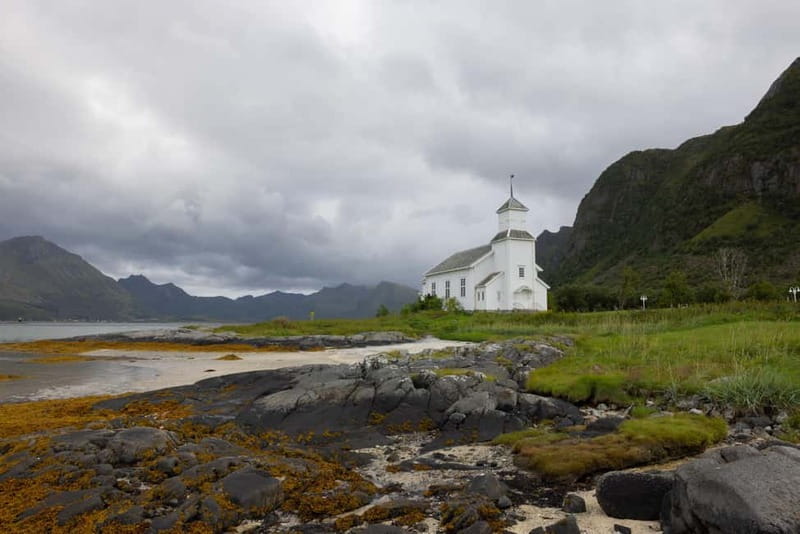
Flakstad Church provides a change of subject from mountain and beach photography. Built in the 1700s, it is one of the oldest churches in the Lofoten Islands and is noted for its Russian architectural style.
The church gives you a chance to photograph human history within the larger setting of the islands. It is also a useful pause in a route otherwise filled with outdoor viewpoints. You can expect the guide to provide context about the building and the local culture, although the tour does not include a separate entrance fee.
Because the itinerary does not promise an interior visit, plan to appreciate the church primarily from the outside unless your guide confirms otherwise. The stop is especially worthwhile if you want a more varied set of photographs than beaches and fishing huts alone.
More Highlights Tours in Norway
- 2- Day Lofoten Top Highlights Photo Tour
★ 4.5 · 23 reviews - North Lofoten Top Highlights Photo Tour (Haukland)
★ 4.3 · 21 reviews - Lofoten Highlights Photo Tour – Henningsvær & Haukland
★ 5.0 · 14 reviews - 5 Highlights Of Lofoten From Svolvær
★ 5.0 · 12 reviews
Hamnøy, the famous red fishing huts, and the classic view
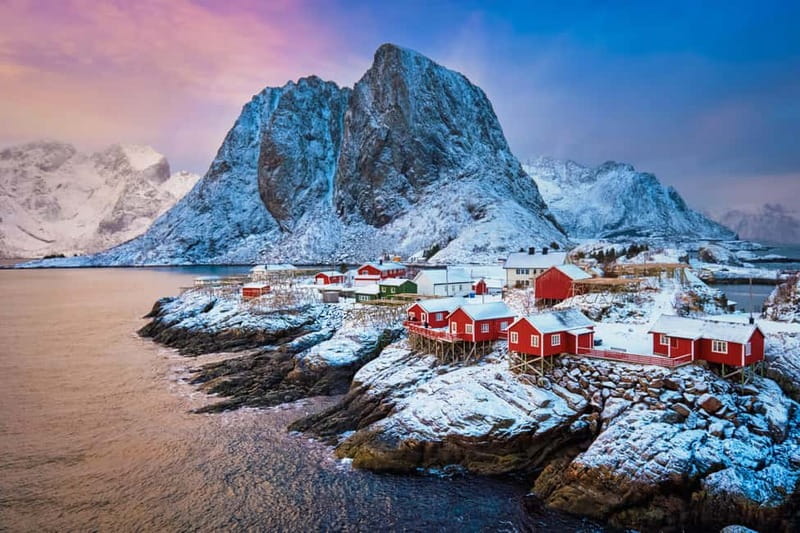
Hamnøy is one of the most recognizable places in Lofoten. Its red fishing huts and dramatic setting have made it a favorite subject for photographers, and the viewpoint gives you the kind of broad scene that explains why the archipelago is so often photographed.
This is likely to be one of the busiest-feeling stops on the route simply because it is so well known. Your advantage is having a guide who can help you think beyond the obvious shot. Look for the relationship between the huts, the water, and the mountains rather than treating the red buildings as an isolated subject.
The guide’s role matters here. A quick roadside photo can be fine, but a photography-focused stop gives you more help with framing and timing. The length of the stop is not specified, so ask how much time is normally allowed if you have a particular camera setup.
Sakrisøy and the yellow rorbuer
Sakrisøy offers a welcome color change. Its yellow rorbuer, or traditional fishing cabins, and wooden fishing racks create a different feel from the red huts at Hamnøy.
The fishing racks are especially useful for adding detail and texture to your photographs. They also help connect the pretty scenery to the working life of the islands. Lofoten is not just a collection of mountain viewpoints, and this stop gives the guide a chance to explain that fishing culture.
As at Hamnøy, take care around private buildings and working areas. The supplied information does not specify any special photography rules, so listen to the guide and avoid assuming that every cabin or rack is simply a prop.
Reine, the southern destination
Reine is one of the most famous villages in Lofoten and forms the southern anchor of the first day. The setting brings together water, steep peaks, and traditional buildings in a compact village scene.
For a photographer, Reine offers both wide views and smaller details. You can work with the village as a whole, then turn toward the waterfront, cabins, or mountain shapes. The stop also gives you a sense of why the southern islands are such a major part of Lofoten itineraries.
The tradeoff is that famous places can feel less private. This tour is designed to show you the highlights, not to promise empty viewpoints. The weather-based route may help your timing, but it cannot guarantee a quiet stop or ideal light.
Day two: beaches, fishing villages, and big northern views
The second day turns toward Haukland, Henningsvær, Kabelvåg, and several stops along the road. It mixes easy-to-recognize Lofoten sights with places that are more about the route and changing conditions.
Haukland Beach beneath steep mountains
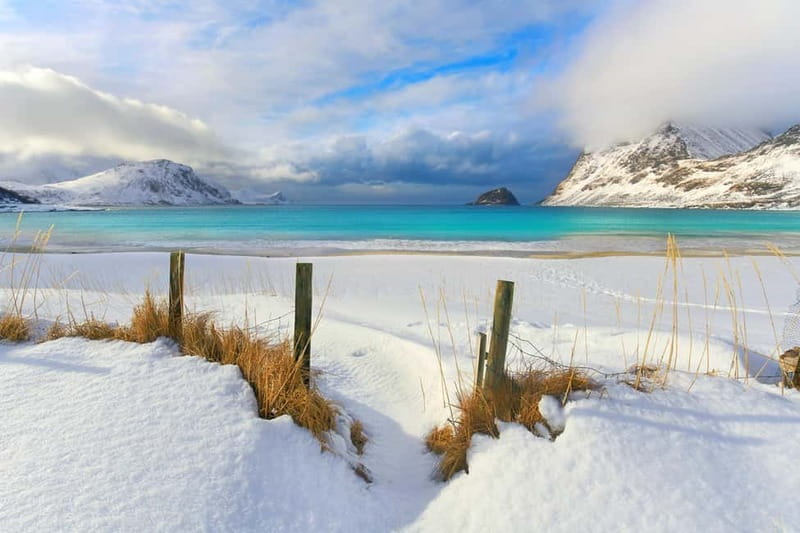
Haukland Beach is another white-sand shore with clear water, but its setting differs from Ramberg. Here, steep mountains rise around the beach, giving your photographs a stronger sense of enclosure.
I like the contrast between the two beach stops. Ramberg can give you a broader open shoreline, while Haukland places the beach more firmly within the mountains. If the weather shifts, the clouds may become part of the photograph rather than a problem.
The tour does not list swimming time or a separate beach activity. Treat Haukland as a scenic and photographic stop. Comfortable shoes and weather-resistant clothing will make the visit easier, since the experience is built around outdoor viewpoints.
Henningsvær and its famous football field
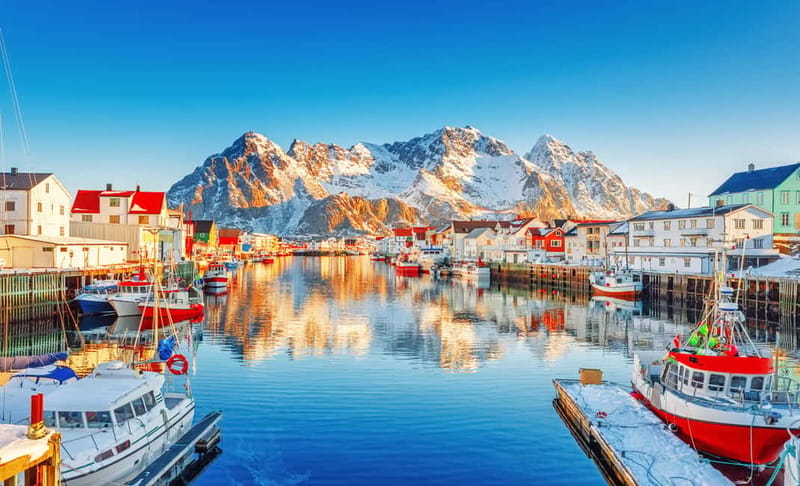
Henningsvær is a traditional fishing village with colorful wooden houses and one of the most famous football fields in Norway. Its position among small islands and waterways makes it visually different from Reine and Hamnøy.
The football field is an especially good example of how ordinary modern life can become part of a striking setting. It is not just another mountain view. You get village details, water, buildings, and the unusual sight of a sports field surrounded by the scenery of Lofoten.
Henningsvær is also one of the places where a guide’s local knowledge adds value. The tour description promises information about history and culture, and the guide can help you understand the village beyond its most photographed angle. Do not expect a long independent visit with unlimited time, since this is one stop on a packed two-day route.
Kabelvåg and the fjord viewpoint
Kabelvåg is a traditional fishing village with a panoramic viewpoint over the fjord. It adds a broader outlook after the closer village scenes at Henningsvær.
The viewpoint is useful for photographers who want scale. The fjord, village, and mountains can be combined in one frame, while changes in visibility can give the scene a very different mood. This is the kind of stop where having a tripod may be helpful, particularly if the light is low or you want to take more deliberate images.
The tour provides a tripod if requested, but you should make that request before the trip rather than assuming one will be waiting in the vehicle. You still need to bring your own camera and any lenses or accessories you want to use.
Rørvik Beach and the effect of the tide
Rørvik Beach is a small bay known for low tides and its position along one of the most scenic roads in the area. The low water can change the pattern of the shore and add reflective surfaces or exposed textures.
This stop is a reminder that Lofoten photographs depend on conditions. A beach can look completely different with a higher or lower tide, a clear sky, or low cloud. The tour does not give a fixed tide schedule, so you should see this as a chance to photograph what the day offers rather than a guaranteed composition.
Tordvalshalsen and the farms below
Tordvalshalsen is a panoramic viewpoint over a valley dotted with farms. It provides a rural view that differs from the fishing villages and coastal beaches.
The farms give the frame a sense of scale and show how people use the land between the mountains. This is a good stop for anyone who wants photographs that include more than dramatic peaks and water. The viewpoint also gives the guide another opportunity to explain local life and geography.
Gimsøystraumen and the moving water
At Gimsøystraumen, the route pauses at a narrow point where Atlantic Ocean currents and the Vestfjord create visible eddies. Moving water can add energy to a two-day collection of still mountain scenes.
This is a particularly useful place to have a tripod if you want to work carefully with shutter speed. The stop is described as a photo stop, so it may be brief, and the guide decides the final timing based on conditions. Watch your footing and follow the guide’s instructions near the water.
What the $269 price gets you
At $269 per person, the price is reasonable for a two-day experience if you value transport and photography guidance. You are paying for a licensed driver, professional guide, hotel pickup and drop-off in Svolvaer, and access to a route that would take planning and confident driving to manage independently.
The small-group format is a major part of the value. A group of seven would give you a more personal experience, while a group of up to 12 would feel less intimate. Since the supplied details use both figures, confirm the expected maximum before paying if group size is important to you.
You must budget separately for food and drinks. Entrance fees are also excluded, although the listed stops do not specify a particular paid attraction. That makes the final cost fairly simple, but you should still plan your meals for two full sightseeing days.
Practical details that affect your experience
Pickup and drop-off are included in Svolvaer. Wait in your hotel lobby 10 minutes before the scheduled pickup and provide your hotel name and mobile number when booking.
The tour is conducted in English. Starting times depend on availability, so check the schedule rather than assuming a standard departure hour. The route order is flexible and may change with weather, availability, and the guide’s judgment.
The experience is not suitable for children under the listed age limits, though the supplied information gives several overlapping restrictions from under two through under ten. It also lists restrictions for people with mobility, visual, or hearing impairments, people with a cold, and people above several different weight limits. Because these details conflict in places, contact Lofoten Lights before booking if any restriction might apply to you.
Free cancellation is available up to 24 hours before the tour for a full refund. You can also reserve now and pay later, which helps if your Lofoten schedule is still taking shape.
Who should book this two-day Lofoten tour?
I would choose this tour if you want to see a wide range of Lofoten without renting a car, and if making better photographs matters as much as checking off villages. It suits adults who can handle long sightseeing days, outdoor stops, and a changing schedule.
It is also a good fit for solo visitors or couples who want a small group rather than a large coach. The guide’s combined driving and photography role is especially useful if you are not comfortable on narrow or unfamiliar roads.
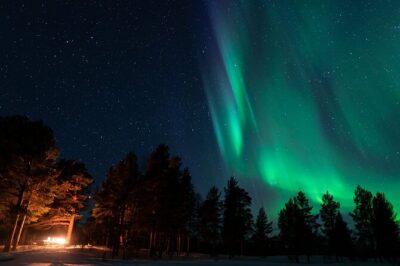
I would think twice if you want a slow stay in one village, long hikes, or complete control over every stop. This is a sightseeing route with many locations, not a specialist photography workshop with guaranteed sunrise, sunset, or northern lights sessions. The phrase arctic lights appears in the description, but no specific aurora viewing schedule is promised, and summer conditions do not guarantee that kind of display.
Should you book it?
Book this tour if your priority is seeing the major Lofoten sights in two days while receiving practical help with photography. Hamnøy, Sakrisøy, Reine, Henningsvær, and the two white-sand beaches give you a strong mix of famous views and local character.
Before booking, confirm the group size, ask for a tripod if needed, and make sure the accessibility and age rules fit your party. At $269, the tour offers solid value for a compact, guide-led trip from Svolvaer to Reine, provided you are comfortable with a full schedule and a route that changes with the weather.
FAQ
Where does the tour begin and end?
The tour includes pickup and drop-off at your hotel in Svolvaer.
How long does the experience last?
It lasts two days. Starting times depend on availability.
What language is the tour conducted in?
The live tour guide speaks English.
What places are included?
The route includes Ramberg Beach, Flakstad Church, Hamnøy, Sakrisøy, Reine, Haukland Beach, Henningsvær, Kabelvåg, Rørvik Beach, Tordvalshalsen, and Gimsøystraumen.
Is the itinerary fixed?
No. Lofoten Lights decides the order according to weather, availability, and the guide’s decision.
Is a tripod provided?
Yes, a tripod is available if requested.
Are food and drinks included?
No. Food and drinks are not included.
Are entrance fees included?
No. Entrance fees are not included.
Can I cancel for a full refund?
Yes. You can cancel up to 24 hours in advance for a full refund.
More Photo Tours in Norway
- South Lofoten Highlights Photo Tour (Summer)
★ 5.0 · 8 reviews - 2-Day Lofoten Highlights Photo Tour (Summer)
★ 5.0 · 8 reviews - North Lofoten Highlights Photo Tour (Summer)
★ 5.0 · 6 reviews - From Svolvær: Midnight sun tour with a photographer
★ 4.1 · 3 reviews
More Photo Tours in Lofoten
- Lofoten: Reine, Hamnøy, and Skariskøya Photo Tour
★ 4.8 · 249 reviews - Svolvær: Reine, Hamnøy, Sakrisøy Photo Tour
★ 4.8 · 53 reviews - Aurora Capture with Photographer
★ 4.5 · 28 reviews - Lofoten: Northern Lights Tour with Photographer
★ 4.8 · 28 reviews
Just added around Svolvaer
- Lofoten Winter Panoramic Tour★ 5.0 · 31 reviews
- Lofoten Highlights Photo Tour – Henningsvær & Haukland★ 5.0 · 14 reviews
- Lofoten VIP PRIVATE tour from Svolvaer★ 5.0 · 13 reviews
- Small Group Luxury Cruise to Trollfjord on a 33m Classic Yacht★ 5.0 · 29 reviews
- Private Full Day Sightseeing Tour from Svolvær to Å★ 5.0 · 12 reviews
- Sea Eagle Safari from Svolvær to Trollfjorden★ 5.0 · 124 reviews
- Lofoten RIB Sea Eagle Safari and Trollfjord Cruise★ 5.0 · 69 reviews
- North Lofoten Highlights Photo Tour (Summer)★ 5.0 · 6 reviews
Photography Sessions, compared.

Tromso Northern Lights Minibus Chase Small Group Tour with Photos
Read our review →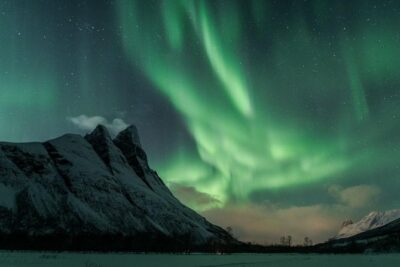
Minibus Northern Lights Chase with Photography from Tromsø
Read our review →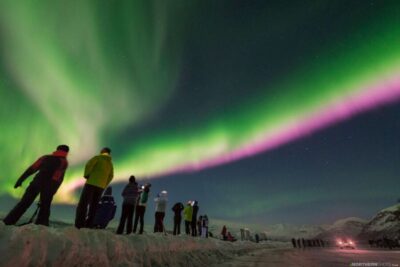
Northern Lights Photography Tour by Bus (or miniBus)
Read our review →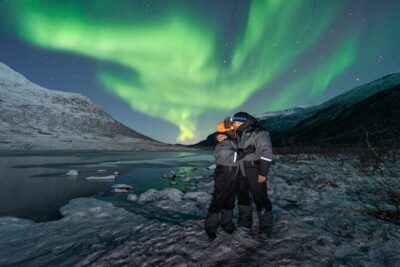
Northern Lights Hunt with The Green Adventure – photos included
Read our review →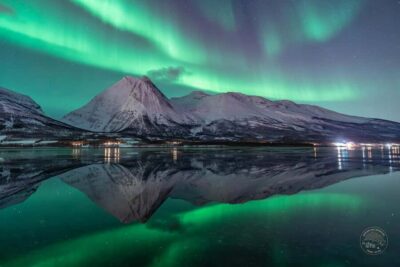
Browse the lists this tour appears in