
Reviewed · CITY TOURS
Free City Walking Tour in Oslo
Oslo’s story comes together quickly on this 90-minute city walk, which links the sharp white Opera House, medieval Akershus Fortress, Nobel Peace Center, Royal Palace, and Parliament. You get a useful first look at both modern Oslo and the older city tucked behind its waterfront.
I like the route’s variety and its practical starting point by the Tiger statue at Jernbanetorget. I also like that guides such as Nicholas, Zoe, Nikola, Yellena, and Mia mix city facts with stories about royal life, Norwegian culture, and daily routines.
The main trade-off is pace. You cover a lot of ground, and one dissatisfied participant felt there was more walking than talking. If you want long museum stops or a slow architectural study, this is not that tour.
Key points to know before you go
- A full central Oslo route in 90 minutes: Walk from the Tiger statue to the Norwegian Parliament, passing major sights along the way.
- Modern and historic Oslo together: See Bjørvika’s Opera House and Munch Museum area, then move through Christiania Square and Akershus Fortress.
- Strong guide-dependent experience: Nicholas, Zoe, Nikola, Yellena, and Mia have each been praised for friendly, clear, entertaining guiding.
- A useful first-day activity: The route gives you a map of central Oslo and helps you decide where to return for a longer visit.
- Free-tour pricing needs a closer look: The listed booking price is $3.45, but tips are expected, with about $10 per person suggested in one comment.
- Group size can reach 30: That is manageable, but you may stand near the edge of the group at busy stops.
Why this short Oslo walk works
I see this tour as an orientation walk rather than a full historical course. In an hour and a half, you move through the city center, hear the main stories, and learn how Oslo’s public spaces fit together.
The route is especially useful because it does not focus on just one kind of Oslo. You get new waterfront architecture, royal institutions, government buildings, arts venues, and a medieval fortress. That mix helps you understand the city’s shape before spending time inside its museums.
Several guides have received praise for keeping the mood light while still explaining the sights clearly. Nikola was noted for taking time with explanations despite chilly weather. Yellena was described as friendly and fun, while Zoe was praised for her easygoing manner and walking pace. Those details matter because an outdoor tour depends as much on delivery as on the route.
I also like the length. Ninety minutes is enough to get your bearings without taking over your day. You can schedule it near the start of your stay, then return to the Opera House, National Museum, Nobel Peace Center, or Akershus Fortress if one of them catches your interest.
More City Tours in Norway
- Oslo: City Sightseeing Hop-On Hop-Off Bus Tour
★ 3.6 · 724 reviews - Oslo: Grand City Sightseeing Tour by Bus with Fjord Cruise
★ 4.6 · 647 reviews - Oslo Combo Tour: Grand City Tour and Oslo Fjord Cruise
★ 4.5 · 555 reviews
Starting at the Tiger statue and Jernbanetorget
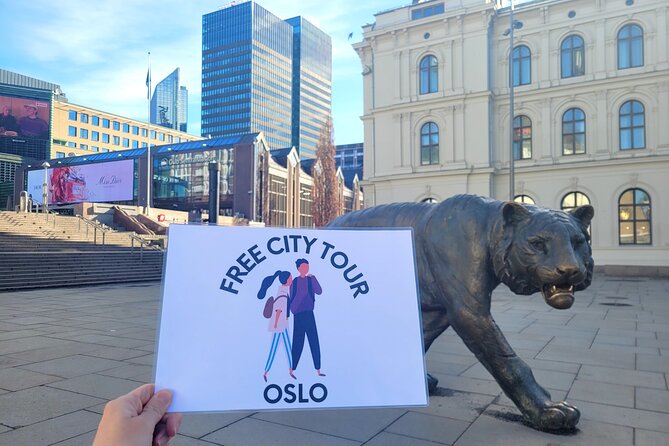
The meeting point is the Tiger sculpture at Jernbanetorget, at the heart of Oslo’s transport network. It is an easy place to reach and a sensible launch point for a walking route through the center.
The opening stop lasts about eight minutes. Do not expect a long lecture here. The value is practical: you meet the guide, gather the group, and begin with a clear sense of where central Oslo sits in relation to the station and waterfront.
The group can include up to 30 people. That is not a tiny personal walk, but it is still small enough for a guide to lead on foot without the feel of a large coach excursion. Stay close when crossing streets or moving through busy public areas.
The Opera House and Oslo’s changing waterfront
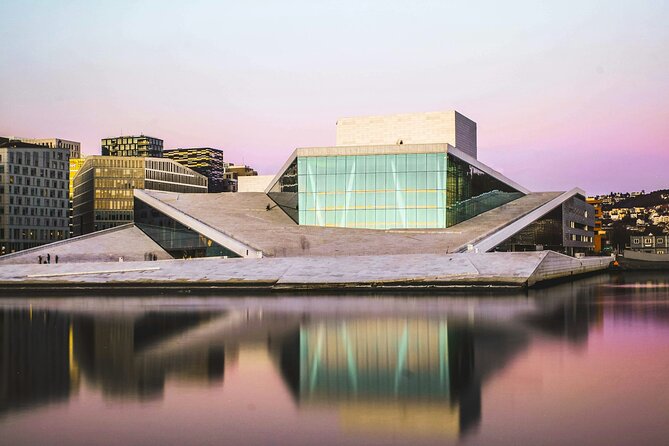
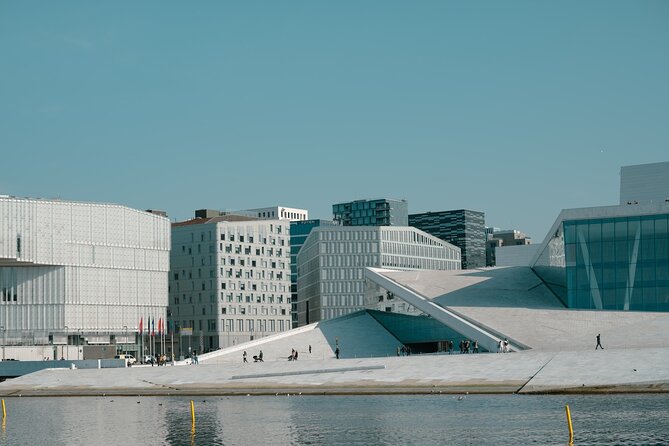
The route then reaches the Oslo Opera House, with about ten minutes devoted to this part of Bjørvika. The guide also brings in the Public Library, the Munch Museum, and Sørenga, giving you a quick look at the city’s newer waterfront districts.
This is one of the most useful parts of the tour for first-time visitors. Oslo’s waterfront has become one of the city’s main public faces, and the modern buildings help explain how the capital has changed. You will not have time for full interior visits, but you get the context needed to choose which places deserve a return visit.
The Opera House is also a good visual contrast to the later fortress and palace stops. The route moves from contemporary civic design to older stone buildings without requiring a long transfer. That variety keeps the walk from feeling like a string of similar government façades.
The itinerary also mentions the smallest stock exchange in the world. It is a quick point of interest rather than a major stop, but small details like this can make a city walk more memorable than a list of famous landmarks alone.
Kvadraturen and Christiania Square
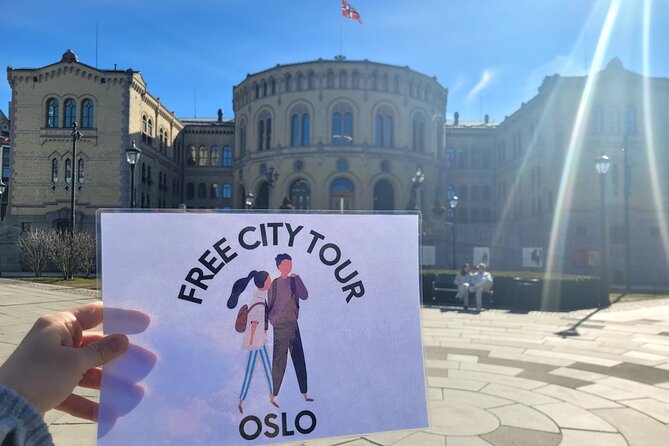
From the waterfront, you continue into Kvadraturen, Oslo’s historic street grid. The stop at Christiania Square lasts about seven minutes.
This part helps you see a different side of central Oslo. After the open waterfront and modern architecture, Kvadraturen gives the walk a more enclosed urban feel. The guide uses the area to explain the city’s earlier development and the story behind Christiania.
The stop is brief, so you should think of it as a historical marker, not a detailed neighborhood tour. If you are interested in old streets and urban history, note where you are and consider returning later at your own pace.
More City Tours in Oslo
- City Sightseeing Oslo Hop-On Hop-Off Bus Tour
★ 3.0 · 455 reviews - Oslo: City Highlights Walking Tour
★ 4.8 · 197 reviews - Oslo City Highlights with Fjord Cruise
★ 4.5 · 128 reviews - Oslo Shore Excursion: City Sightseeing Oslo Hop-On Hop-Off Bus Tour
★ 3.0 · 121 reviews
Akershus Fortress and Alfred Nobel
Akershus Castle and Fortress is the route’s most substantial historic setting, with about eight minutes planned here. The guide also connects the fortress area with Alfred Nobel.
This is a strong choice of stop. The fortress gives you one of the route’s clearest links to Oslo’s past, while its position near the harbor adds a good change of scenery. The supplied details indicate that the walk includes views from the top of the fortress area, so this is one place where the route offers more than a pavement-side explanation.
The Alfred Nobel connection leads naturally toward the Nobel Peace Center later in the walk. You get a thread running through the tour rather than unrelated facts at every corner.
Still, eight minutes is short for a site with this much to see. You should not expect a full fortress visit or time to explore every courtyard. If Akershus interests you, plan to return with more time after the tour.
Aker Brygge, the National Museum, and Nobel Peace Center
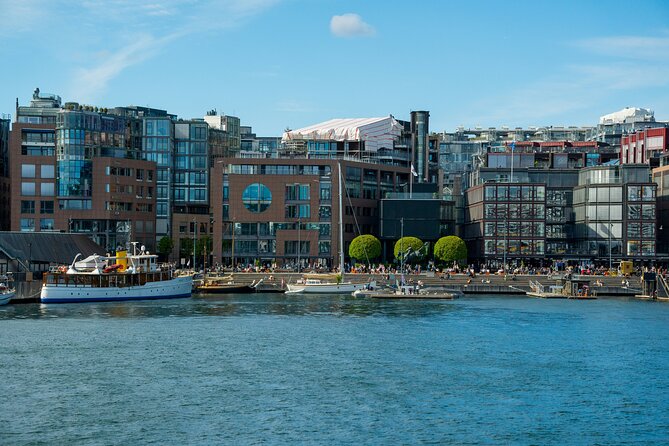
The next seven-minute section takes in Aker Brygge, the National Museum, and the Nobel Peace Center. These attractions sit in an area where waterfront dining, public spaces, culture, and modern development meet.
For you, the benefit is choice. The guide gives you enough orientation to decide if you want a museum visit, a closer look at the Nobel exhibits, or a relaxed walk along the harbor later. Since the tour does not include extended admission to these institutions, treat this as an introduction.
Aker Brygge also gives the route a more contemporary social setting. You are no longer looking only at monuments. You are seeing how Oslo uses its waterfront in everyday life, which supports the tour’s promise to cover Norwegian lifestyle as well as history.
City Hall and the meaning of Rådhuset
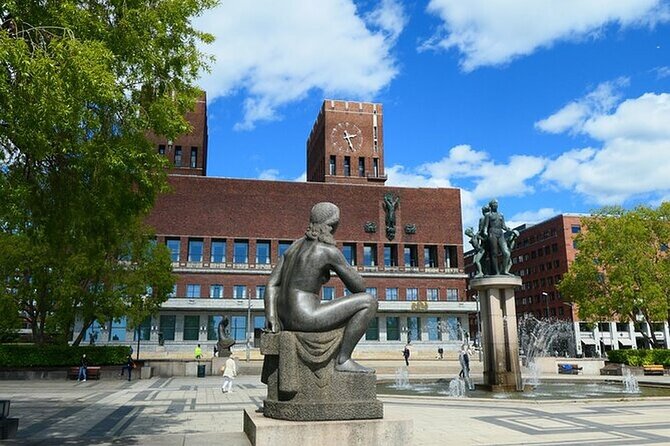
Oslo City Hall, or Rådhuset, receives about ten minutes, one of the longer stops on the route. That extra time makes sense. City Hall is central to Oslo’s public identity and closely tied to the Nobel Peace Prize ceremony.
This is another point where the tour connects buildings with civic life. The guide can explain why the building matters rather than simply naming it and moving on. The route’s Nobel thread, beginning near Akershus and continuing at the Peace Center, gains a clear public setting here.
You should expect an exterior-focused stop. The experience is a walking overview, and the supplied details do not promise an interior visit. If you want to study the murals or rooms inside City Hall, save that for a separate visit.
Nationaltheatret and Henrik Ibsen
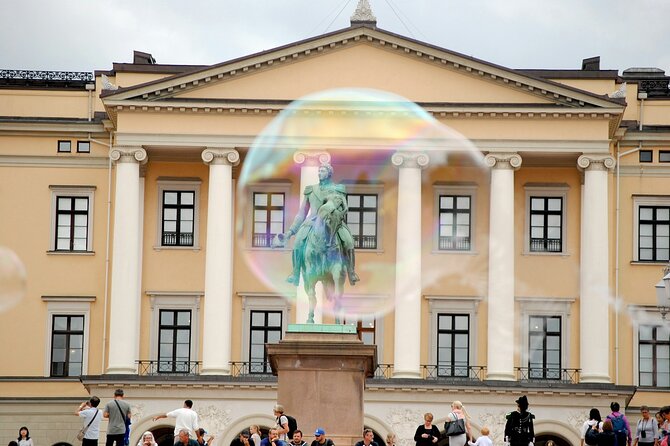
The walk continues to Nationaltheatret for about six minutes, with Henrik Ibsen as the main cultural reference.
This is a useful reminder that Oslo’s identity is not only royal and political. Theatre and literature are part of the city’s public story, and Ibsen gives the guide a way to introduce Norway’s cultural life through one of its best-known writers.
The stop is compact. You will receive a short introduction rather than a literary seminar. That is appropriate for the route, but readers with a strong interest in Ibsen may want to note the area for a later visit.
The University Aula and Edvard Munch
At the University Aula, the guide spends about four minutes discussing the place where Edvard Munch painted. This is the shortest scheduled stop, but it adds an important art connection to the route.
The brief visit works as a link between Oslo’s public institutions and its artists. You have already heard about the Munch Museum near Bjørvika, and now you get another point of contact with Munch’s work in a university setting.
Because the stop lasts only a few minutes, do not expect a detailed examination of the paintings or the building. Its real value is in showing how art appears across Oslo, not just inside a single museum.
The Royal Palace and Norwegian royal life
The Royal Palace receives about eight minutes and provides the clearest look at Norway’s monarchy. The guide shares stories about the Norwegian royal family, making this more personal than a simple exterior photo stop.
I like this part because royal institutions can seem formal and distant when you see them on your own. A guide gives you the background needed to understand the palace’s role in modern Norway and how it fits into the city center.
Again, the stop is outside-focused according to the available details. You get the setting and the story, but not a full palace tour. If royal history is a priority, use the walk to decide if you want to spend more time in the area.
Finishing at the Norwegian Parliament
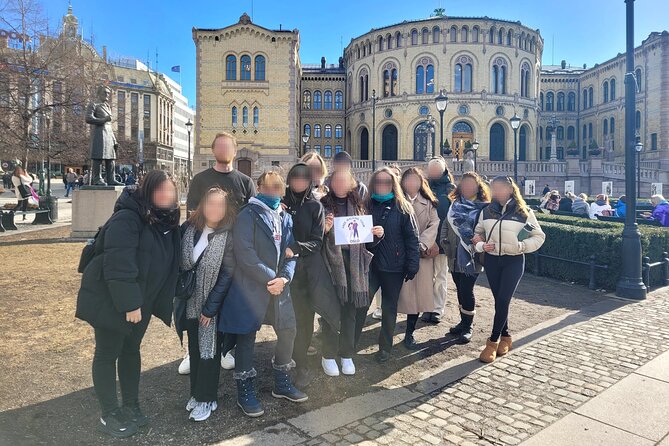
The final scheduled stop is the Norwegian Parliament on Karl Johans gate. The tour ends at Karl Johans gt. 22, about ten minutes on foot from the Tiger statue.
That ending is convenient. You finish near one of Oslo’s main central streets, with public transport close by and many other sights within reach. The Parliament stop also completes the tour’s civic arc, moving from royal life and Nobel institutions to the country’s elected government.
The guide may finish the formal walk here, but you are well placed to continue exploring. You can return toward the station, walk back toward the palace, or use the location as a starting point for your next Oslo stop.
How much value do you get for $3.45?
At $3.45 per person, the listed price is very low for a 90-minute guided walk covering this much central Oslo. The value is strongest if you want orientation, basic context, and a list of places to revisit rather than admission to attractions.
There is one important wrinkle. The tour follows a free-walking-tour model, and a comment advises that you may find the same type of activity by searching for a free Oslo walking tour, with tips of about $10 per person expected. In practice, the final cost may be shaped more by the tip than by the small booking charge.
That does not automatically make the experience poor value. You are paying for a guide’s time, route planning, and storytelling, while the booking platform gives you a confirmed place. Still, compare the total expected cost before booking, especially if you are traveling with a family or larger group.
Pace, weather, and group size
This is an outdoor walk, so Oslo weather matters. One positive account specifically noted that Nikola stayed calm and unhurried in chilly conditions. That suggests the guides are prepared to keep the walk moving without making cold weather feel like a race.
The feedback is not perfectly uniform. One person felt the tour moved too quickly and finished about 20 minutes early, while another felt there was too much walking and not enough explanation. Other accounts praise the easy pace, friendly style, and useful amount of information.
I would treat this as a brisk city walk with frequent explanations, not a slow tour with long pauses. Wear comfortable shoes and dress for the forecast. If you need a highly detailed lecture at every stop, the short schedule may feel tight.
The maximum group size is 30. The route is near public transportation, service animals are allowed, and most people can take part. Confirmation arrives at booking, and you can cancel for a full refund up to 24 hours before the start time. Cancellations or changes inside 24 hours are not refunded or accepted, and the tour requires a minimum number of participants.
Who should book this Oslo walking tour?
I would choose this walk near the beginning of a first visit to Oslo. It gives you a clear map of the center and introduces enough landmarks to help you plan the rest of your stay.
It suits you best if you want:
- A short introduction to Oslo’s major central sights
- Stories about monarchy, government, Nobel history, art, and daily life
- A mix of waterfront architecture and older city districts
- A walking pace that covers plenty of ground
- A low-cost way to begin exploring
I would choose something else if you want interior access to museums, a detailed fortress tour, or long, quiet time at each monument. The route is designed to show you the city and explain its main connections, not replace dedicated visits to the attractions.
Should you book it?
Yes, if you want a lively first look at central Oslo and understand that this is a quick orientation walk. The mix of the Opera House, Bjørvika, Akershus Fortress, Aker Brygge, City Hall, Royal Palace, and Parliament gives you a lot for 90 minutes.
Book with realistic expectations about the free-tour model, possible tipping, and the group size. Choose it early in your stay, stay near the guide, and mark the places you want to revisit. With that approach, the tour offers solid value and a useful introduction to Oslo.
FAQ
How long does the Free City Walking Tour in Oslo last?
The tour lasts approximately 1 hour and 30 minutes.
Where does the tour start?
It starts at the Tiger sculpture at Jernbanetorget, 0154 Oslo, Norway.
Where does the tour end?
The tour ends by the Norwegian Parliament at Karl Johans gt. 22, 0026 Oslo, about 10 minutes on foot from the Tiger statue.
What sights are included on the route?
The route includes the Oslo Opera House, Kvadraturen and Christiania Square, Akershus Castle and Fortress, Aker Brygge, the National Museum area, Nobel Peace Center, Oslo City Hall, Nationaltheatret, the University Aula, the Royal Palace, and the Norwegian Parliament.
How much does the tour cost?
The listed price is $3.45 per person. It follows a free-tour model, and tips are expected. One supplied detail suggests about $10 per person as a typical tip.
How large can the group be?
The tour can have a maximum of 30 participants.
Is the tour accessible by public transportation?
Yes. The meeting point is near public transportation.
Can I cancel for a full refund?
Yes, if you cancel at least 24 hours before the experience start time. Cancellations or changes made less than 24 hours before the start time are not refunded or accepted.
More Walking Tours in Oslo
- Oslo: Historic Myths & Legends Evening Walking Tour
★ 4.8 · 408 reviews - Taste of Oslo Walking Tour
★ 4.5 · 282 reviews - Central Oslo Guided Walking Tour with Local Guide
★ 4.5 · 278 reviews - Oslo: Snowy Forest Torchlight Walk with Campfire
★ 4.6 · 254 reviews
More Walking Tours in Norway
- Oslo Nature Walks: Island Hopping Tour
★ 4.8 · 2,713 reviews - Oslo Nature Walks: Island hopping
★ 5.0 · 570 reviews - Oslo: Best of Oslo Walking Tour
★ 4.5 · 458 reviews - Oslo: Guided Walking Tour of Central Oslo
★ 4.7 · 438 reviews
Just added around Oslo
- Oslo Winter Highlights Bike Tour★ 5.0 · 36 reviews
- Unknown war. Oslo and Norway during 1940-45★ 5.0 · 74 reviews
- The Viking Planet Museum – Mini Group (4 adults)★ 4.0 · 16 reviews
- 4 hours Best View of the Oslofjord Winter Edition★ 4.0 · 15 reviews
- The Ultimate Norwegian Skiing Experience★ 5.0 · 16 reviews
- The Ultimate Study of the Human Form at Vigeland’s Sculpture Park with a Local★ 4.0 · 14 reviews
- The Viking Planet Museum Ticket★ 4.0 · 197 reviews
- The Oslo Beer Adventure★ 4.5 · 11 reviews
City Tours, compared.

City Archipelago Sightseeing Cruise with Guide
Read our review →

Group Walking Tour – City Highlights – 2 Hours
Read our review →
City Sightseeing Copenhagen Hop-On Hop-Off Bus Tour
Read our review →
Browse the lists this tour appears in