

Reviewed · WALKING TOURS
Oslo & Vigeland Park Private Walking Tour
Oslo’s best introduction may be its simplest: walk from the Nobel Peace Center through the royal and civic heart of town, then finish among more than 200 Vigeland sculptures. This private tour gives you the city’s main landmarks in one tidy outing, with a guide to explain what you are seeing.
I like the private format, since your group can set the pace and ask about the subjects that interest you most. I also like the route’s mix of power, art, and everyday Oslo, from the Norwegian Parliament and Royal Palace to the old streets of Kvadraturen and the views from Akershus Fortress.
The main caution is time. Three hours covers a lot of ground, but the city walk gives only about an hour to Vigeland Park. If the sculpture park is your top reason for booking, tell your guide early and ask to give it more attention.
Key points to know before you book

- The tour begins at the Nobel Peace Center: You start in central Oslo and walk through the city’s main public spaces.
- It is private and English-language: Only your group takes part, so questions and pacing are more flexible than on a large group walk.
- Vigeland Park is the grand finale: The tour includes public transport to the park and free entry, with about one hour there.
- The route covers several sides of Oslo: Expect royal landmarks, government buildings, medieval defenses, Renaissance town planning, and modern cultural history.
- You need a moderate fitness level: Most of the outing is on foot, with some gravel or unpaved paths and unavoidable city traffic noise.
- The price reflects personal guiding: At $278.71 per person, value depends heavily on your group size and how much you value a private introduction to Oslo.
From the Nobel Peace Center into central Oslo
The meeting point is the Nobel Peace Center at Brynjulf Bulls plass, a useful starting place near the waterfront and the central city. The building occupies a former train station, and your guide uses it to explain Alfred Nobel and why the Nobel Peace Prize is awarded in Norway.
That opening gives the tour a clear theme. Oslo is not only a capital of palaces and government offices. It is also tied to international diplomacy and the public ideals represented by the Peace Prize. You spend about ten minutes here, so this is an exterior introduction rather than a full museum visit.
From there, the route moves to Oslo City Hall. Its bold architecture can look severe at first, but the interior artwork and decorative themes connect the building to Norwegian history, culture, and working life. The stop is brief, yet it helps you see City Hall as more than an administrative office.
You then pass Nationaltheatret, Norway’s main stage for classic and new theatre productions for a century. Five minutes is enough to place the building within Oslo’s cultural life, though not enough for a performance or interior tour. I would treat this as a useful orientation stop, not a major attraction on its own.
More Walking Tours in Norway
- Oslo Nature Walks: Island Hopping Tour
★ 4.8 · 2,713 reviews - Oslo Nature Walks: Island hopping
★ 5.0 · 570 reviews - Oslo: Best of Oslo Walking Tour
★ 4.5 · 458 reviews
The Royal Palace and Karl Johans Gate
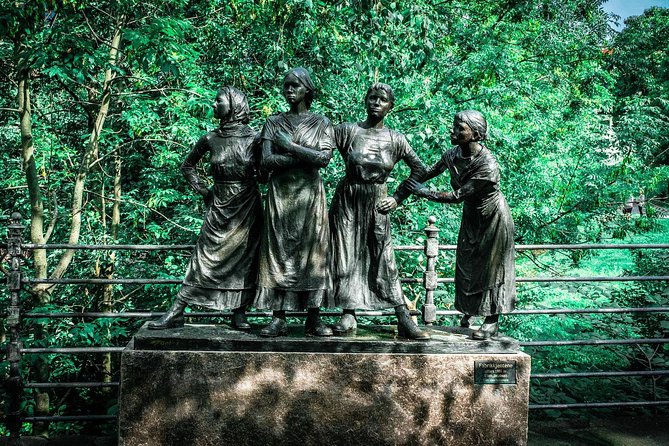
The Royal Palace is the official residence of Norway’s monarch, and much of the Royal Court works there. The tour allows about ten minutes, giving you time to understand the palace’s role in present-day Norway and to see how royal space fits into the center of the capital.
The route then follows Karl Johans Gate, Oslo’s main pedestrian street. It takes its name from Karl III Johan, the nineteenth-century King of Norway. This is one of the easiest parts of the tour for getting your bearings, since the street links several major institutions and public spaces.
A private guide can make this stretch more useful than a quick stroll on your own. You can ask how the palace, theatre, Parliament, and public squares fit together, rather than seeing them as disconnected photo stops. Still, remember that the tour is moving through a city center. Traffic noise and urban activity are part of the setting, even on quieter sections of the route.
Parliament, democracy, and the old town grid
The Norwegian Parliament overlooks Eidsvolls Plass and represents the country’s central democratic institution. The stop lasts about five minutes, so expect a short explanation and exterior viewing rather than a parliamentary visit.
After the royal and governmental landmarks, the route changes character in Kvadraturen. At Christiania Torv, the name recalls an earlier name for Oslo, while the rectangular street pattern reflects King Christian IV’s Renaissance town. The stop at Christian IV’s Glove helps connect the square with that earlier city plan.
This part is valuable because it moves beyond the standard palace-and-shopping-street version of Oslo. You get a glimpse of how the city was rebuilt and organized. The five-minute timing means the value comes from your guide’s explanation, not from lingering at one monument.
Bankplassen adds another small piece of the city’s story. Its name refers to the former location of the Bank of Norway. Like Christiania Torv, it is a short stop, but it helps you read Oslo’s streets as evidence of past institutions rather than simply as places to pass through.
Akershus Fortress brings the strongest view
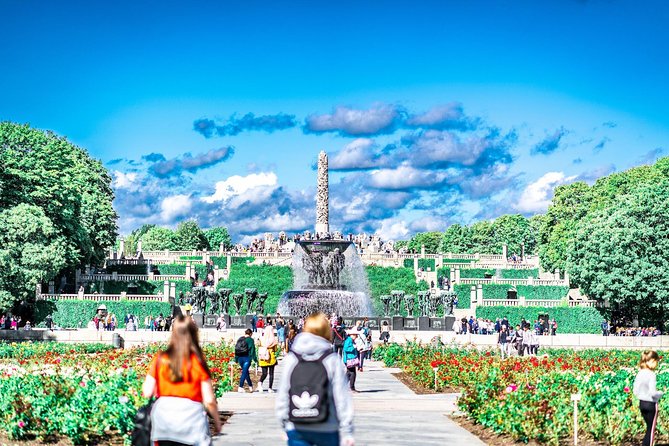
Akershus Fortress is the route’s most substantial central Oslo stop, with about fifteen minutes allowed. The site began as a medieval fortress and later became a Renaissance royal residence under King Christian IV in the seventeenth century.
The setting matters as much as the buildings. From the fortress, you can look toward the Oslo fjord, giving the walking tour a welcome open-air pause after streets, squares, and civic buildings. It is also a good place to ask your guide how Oslo’s defensive past shaped the waterfront.
The short timing is the tradeoff. You will not have an extended fortress visit, and the tour does not promise admission to interior rooms or separate museum time. If you want to explore Akershus in detail, plan to return independently. For a first look, though, this stop adds medieval and military context to a route otherwise centered on modern civic life.
More Walking Tours in Oslo
- Oslo: Guided Walking Tour of Central Oslo
★ 4.7 · 438 reviews - Oslo: Historic Myths & Legends Evening Walking Tour
★ 4.8 · 408 reviews - Taste of Oslo Walking Tour
★ 4.5 · 282 reviews - Central Oslo Guided Walking Tour with Local Guide
★ 4.5 · 278 reviews
Taking public transport to Vigeland Park
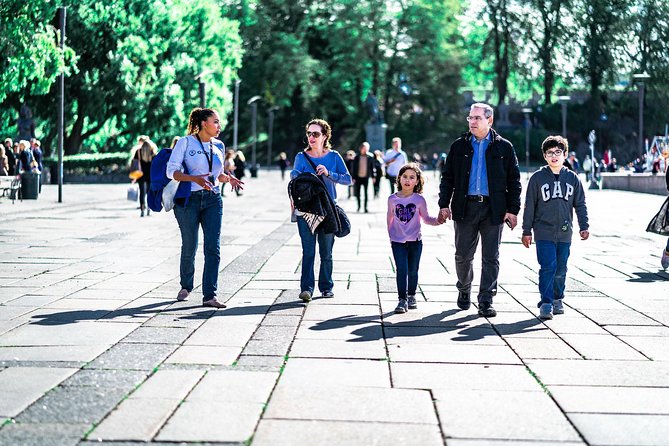
The tour includes a public transport ticket to Vigeland Park, which is important because the park lies outside the compact central walking route. You do not need to arrange that part of the journey yourself, although the experience remains a walking tour rather than a private vehicle excursion.
The change from city streets to a large sculpture park gives the outing a strong second half. You move from Norway’s political and royal center to the work of one artist, Gustav Vigeland. The park contains more than 200 sculptures made by Vigeland alone, giving you a concentrated look at his artistic world.
The tour allows about one hour in the park. That is enough to see the main sequence of sculptures and choose a favorite, but it can feel short if art is your main interest. One useful tip is to say so at the start. The provider’s own guidance for private outings makes clear that a specific interest can help the guide shape the time better.
The park is also where the tour ends, at Nobels gate. You may continue exploring after the official tour, then make your own way back by foot or public transport. That open ending is practical, especially if you would rather linger among the sculptures than hurry back to central Oslo.
What the private format really adds

The private setup is the experience’s biggest advantage. You are not sharing the guide with a large group, so your questions can shape the walk. One guide, Diana, is specifically praised in the supplied feedback for making a first morning in Oslo useful and enjoyable, especially through historical context and small facts that help you get oriented.
Another guide, mentioned by name as well, is Cline’s guide in the French-language feedback, though the tour itself is offered in English. That account describes a guide who stayed beyond the scheduled time to help with the metro and ticket arrangements. You should not assume extra time is guaranteed, but the example shows why a private guide can be useful when you need help understanding Oslo’s transport system at the end.
The private format also makes the tour a better fit for families, couples, or small groups with different interests. Someone interested in royalty can ask for more palace context. An architecture fan can focus on City Hall and the Renaissance street grid. An art lover can request more time at Vigeland Park.
The limit is that flexibility depends on speaking up. If you remain silent, the guide may follow the standard balance of central sights and sculpture park. State your priorities early, especially if you want to shorten the city portion or spend longer at Vigeland.
Price, pace, and physical demands
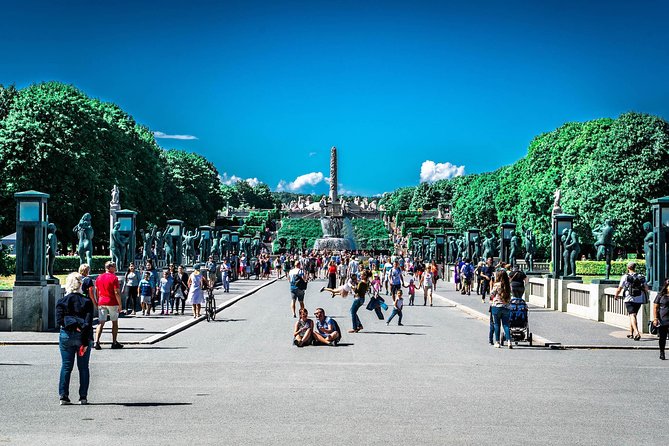
At $278.71 per person, this is not a budget walking tour. The price makes more sense for a small group that values a private guide, personal questions, and a planned route connecting places that are spread across Oslo. For one or two people, it is a significant expense. For a larger private group, group discounts may improve the value, though the exact discount is not specified.
The tour lasts about three hours, and the listed stops add up to roughly two hours and twenty-five minutes before allowing for walking and public transport. That tells you something about the pace: this is an overview, not a slow museum-style visit.
You should be comfortable walking for most of the outing. Some paths in Vigeland Park are gravel or unpaved, and the tour operates in all weather. Wear comfortable shoes and suitable clothing. Service animals are allowed, and the route is near public transport.
The center of Oslo can be noisy. Traffic sounds are unavoidable in several areas, so this is not a quiet nature walk until you reach the sculpture park. The route is also not presented as fully accessible for every mobility level, and the stated guidance calls for moderate physical fitness.
Who will get the most from this Oslo walk?
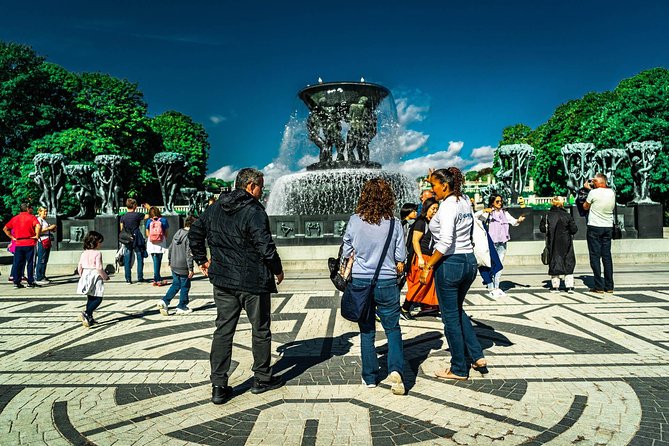
I would choose this tour for a first visit, particularly if you have only one morning or afternoon to understand the city’s layout. It introduces the Nobel Peace Center, City Hall, theatre district, palace, main pedestrian street, Parliament, fortress, old town grid, and Vigeland Park without making you plan the connections.
It also suits you if you prefer personal conversation to a fixed large-group script. The guide can explain why a stop matters, answer questions about Norwegian institutions, and help you make sense of the public transport ride to the park.
I would hesitate if you want long visits inside buildings. Most stops last from five to fifteen minutes, and the included attraction is Vigeland Park rather than museum admission. You should also think twice if you mainly want Vigeland Park. An hour there may leave you wishing the tour had started at the sculptures.
The strongest plan is to use this as an orientation walk, then return on your own to the place that caught your interest. The end point at Vigeland Park makes that easy, since you are free to stay after the guide leaves.
Should you book the Oslo and Vigeland Park tour?
Book it if you want a private first look at Oslo with a human guide, a sensible central route, and a final hour among Gustav Vigeland’s sculptures. The route offers more than postcard sights, especially at Christiania Torv, Bankplassen, and Akershus Fortress.
Skip it if you want a slow art visit, extensive interior access, or the lowest possible price. The tour’s value comes from its range and personal format, not from long time at each stop.
For most first-time visitors with limited time, I see it as a useful way to get oriented. Tell your guide what matters most, wear shoes for gravel and city pavement, and protect enough energy for Vigeland Park. That small bit of planning will make the three hours work much better.
FAQ
How long does the Oslo and Vigeland Park tour last?
The tour lasts approximately three hours.
Where does the tour begin?
It begins at the Nobel Peace Center, Brynjulf Bulls plass 1, 0250 Oslo, Norway.
Where does the tour end?
It ends at Vigeland Park, Nobels gate 32, 0268 Oslo, Norway.
Is the tour private?
Yes. Only your group participates in the private activity.
What language is offered?
The tour is offered in English.
Is public transport included?
Yes. A public transport ticket to Vigeland Park is included.
Is entry to Vigeland Park included?
Yes. Vigeland Park entry is included, and there is no admission charge listed for the park.
Can I stay at Vigeland Park after the tour?
Yes. The tour ends there, so you may continue enjoying the park afterward.
What should I wear?
Wear comfortable clothing suitable for the weather. The tour operates in all weather, and parts of the route use gravel or unpaved walkways.
Can I cancel for a full refund?
Yes, if you cancel at least 24 hours before the experience start time. Cancellations made less than 24 hours in advance are not refunded, and late changes are not accepted.
Just added around Oslo
- Oslo Winter Highlights Bike Tour★ 5.0 · 36 reviews
- Unknown war. Oslo and Norway during 1940-45★ 5.0 · 74 reviews
- The Viking Planet Museum – Mini Group (4 adults)★ 4.0 · 16 reviews
- 4 hours Best View of the Oslofjord Winter Edition★ 4.0 · 15 reviews
- The Ultimate Norwegian Skiing Experience★ 5.0 · 16 reviews
- The Ultimate Study of the Human Form at Vigeland’s Sculpture Park with a Local★ 4.0 · 14 reviews
- The Viking Planet Museum Ticket★ 4.0 · 197 reviews
- The Oslo Beer Adventure★ 4.5 · 11 reviews
Walking Tours, compared.

Past & Present Small Group Guided Walking Tour
Read our review →
Walking Tour in Bergen of the Past and Present
Read our review →
Browse the lists this tour appears in